Sustainable Development Goals (SDGs), Funding and Accountability for sustainable projects?
What are Sustainable Development Goals? ” the United Nations adopted the new post-2015 development agenda. The new proposals – to be achieved by 2030- set 17 new ‘sustainable’ development goals (SDGs) and 169 targets. Some, like Oxfam, see the SDGs as a country budgeting and prioritization as well as an international fundraising tool. They cite that “government revenue currently funds 77% of spending…aligned with government priorities, balanced between investment and recurrent and easy to implement than donor-funded spending…” National investments are vital, but how much has the world used the SDGs to target investments and foster sustainable results?
Using results data such as that of the sectoral SDGs, countries can also ensure accountability for the policies implemented to reduce global and local inequities, but we must learn from the data. Over halfway to the goal, data is being collected, and while there is robust monitoring by countries who have built their M&E systems, other countries are faltering. “A recent report by Paris21 found even highly developed countries are still not able to report more than 40-50% of the SDG indicators” and “only 44% of SDG indicators have sufficient data for proper global and regional monitoring”. Further, there is very little evaluation or transparent accountability. Some of the data illuminate vitally need-to-know-for-better-programming. SDG data shows good news that Western and Asian countries have done better than most of the world 2015-19… but there is a lot of missing data while other data shows staggering inequitiessuch as these:
In Vietnam, a child born into the majority Kinh, or Viet, ethnic group is three and a half times less likely to die in his or her first five years than a child from other Vietnamese ethnic groups.
In the United States, a black woman is four times more likely to die in childbirth than a white woman.
So are we using the SDG data to better target funding and improve design? This is the kind of evaluative learning (or at least sharing by those that are doing it :)) that is missing. As my colleague and friend Sanjeev Sridharan writes on Rethinking Evaluation, “As a field we need to more clearly understand evaluation’s role in addressing inequities and promoting inclusion” including “Promoting a Culture of Learning for Evaluation – these include focus on utilization and integration of evaluation into policy and programs.” How well learning is integrating is unknown.
The private sector is ever-being pushed to fund more of such development costs, only marginally successfully, as public sector expenditures are squeezed. Yet the G20 estimates that $2.5 TRILLION is needed every year to meet the SDG goals. As we have seen at Impact Guild, the push to incentivize private commitments is faltering. “To ensure its sustainability, the private sector has specific interests in securing long-term production along commodity supply chains, while reducing their environmental and social impacts and mitigating risks… The long-term economic impacts of funding projects that support the sustainability agenda are, thus, clearly understood. However, additional capital needs to flow into areas that address the risks appropriately. For example, much remains to be done to factor climate change as a risk variable into emerging markets that face the largest financing gap in achieving the SDGs.” Further, if decreased funding trends continue, by 2030, at minimum 400 million people will still live on less than $1.25 a day; around 650 million people will be undernourished, and nearly 1 billion people will be without energy access. So we’re not meeting the SDGs, they’re being derailed by COVID in places, and we aren’t beginning to cost out the need to address climate change and its effects on global development…. so now what?
To ensure that giving everyone a fair chance in life is more than just a slogan; accountability is crucial. This should include a commitment from world leaders to report on progress on “leaving no one behind” in the SDG follow-up and review framework established for the post-2015 agenda and for the private sector to loudly track their investments across the SDGs. For as The Center for American Progress wrote, money and results are key: We must “measure success in terms of outcomes for people, rather than in inputs—such as the amount of money spent on a project—as well as in terms of national or global outcomes” and that “policymakers at the global level and in each country should task a support team of researchers with undertaking an analysis of each commitment.”
A further concern. While we seem to measure the statistics periodically and see funding allocated to SDG priorities, but there are few causal links drawn between intensity in investment in any SDG goal and sustained results. To what degree are the donations/ investments into the SDGs linked to improvements? Without measuring causality or attribution, it could be a case of “A rising tide lifts all boats” as economies improve or, as Covid-related economic decline wiped out 20 years of development gains as Bill Gates noted last year. We need proof that trillions of dollars of international “Sustainable development” programs have any sustained impact beyond the years of intervention.
We must do more evaluation and learn from SDG data for better targeting of investments and do ex-post sustainability evaluations to see what was most sustained, impactful, and relevant. Donors should raise more funds to meet needs and consider only funding what could be sustained locally. Given the still uncounted demands on global development funding, we can no longer hope or wait for global mobilization of trillions given multiple crises pushing more of the world into crisis. Let’s focus now.
Ex-post Eval Week: Exiting For Sustainability by Jindra Cekan
Reblogged from AEA: https://aea365.org/blog/ex-post-eval-week-exiting-for-sustainability-by-jindra-cekan-2/ January 22, 2021
Jindra Cekan
Hello. My name is Jindra Cekan, and I am the Founder and Catalyst of Valuing Voices at Cekan Consulting LLC. Our research, evaluation and advocacy network have been working on post-project (ex-post) evaluations since 2013. I have loved giraffes for decades and fund conservation efforts (see pix).
Our planet is in trouble as are millions of species, including these twiga giraffes and billions of homo-sapiens. Yet in global development we evaluate projects based on their sectoral, e.g. economic, social, educational, human rights etc., results, with barely a glance at the natural systems on which they rest. IDEAS Prague featured Andy Rowe and Michael Quinn Patton who showed that I too have been blind to this aspect of sustainability.
I have argued ad nauseum that the OECD’s definition of projected sustainability and impact don’t give a hoot about sustaining lives and livelihoods.. If we did, we would not just claim we do ‘sustainable development’ and invest in ‘Sustainable Development Goals’ but go about proving how well, for how long, by whom, after closeout.
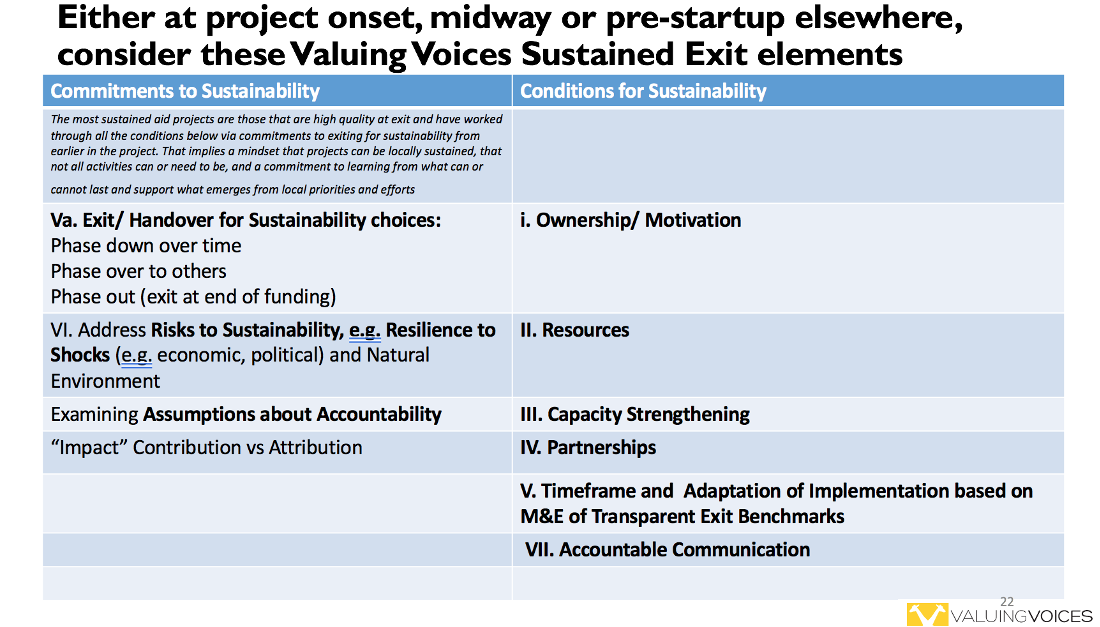
After hearing Rowe, I added to my Sustained Exit Checklists new elements about how we must evaluate Risks to Sustainability and Resilience to Shocks that included the natural environment. I added Adaptation to Implementation based on feedback on how much implementation would need to change based in part on climatic changes.
Source: Author’s Sustained Exit training (December 2020)
Lessons Learned:
Yet new evaluation thinking by Rowe, Michael Quinn Patton, Astrid Brouselle/ Jim McDavid take us a quantum leap beyond. We must ask how can any intervention be sustained without evaluating the context in which it operates. Is it resilient to environmental threats? Can participants adapt to shocks,? Have we assessed and mitigated the environmental impacts of our interventions? As Professor Brouselle writes, “changing our way of thinking about interventions when designing and evaluating them…. away from our many exploitation systems that lead to exhaustion of resources and extermination of many species.”
This 2020 new thinking includes ascertaining:
(Andy Rowe) Ecosystems of biotic natural capital and abiotic natural capital (from trees to minerals) with effects on health, education, public safety/ climate risk and community development
(Astrid Brouselle and Jim McDavid) Human systems that affect our interventions, including: Power relations, prosperity, equity and we need to make trade-offs between environment and development goals clear.
We have miles to go of systems and values to change. Please read this and let’s start sustaining NOW.
Rad Resources:
Rowe, A. (2019). Sustainability-read evaluation: A call to action. In G. Jules (Ed.) Evaluating Sustainability: Evaluative Support for Managing Processes in the Public Interest. New Directions for Evaluation, 162, 29-48.
Michael Quinn Patton (2020) Evaluation Criteria for Evaluating Transformation: Implications for the Coronavirus Pandemic and the Global Climate Emergency. In the American Journal of Evaluationhttps://journals.sagepub.com/doi/abs/10.1177/1098214020933689
This week, AEA365 is celebrating Ex-post Eval Week during which blog authors share lessons from project exits and ex-post evaluations. Am grateful to the American Evaluation Association that we could share these resources….
As a global development industry, we have almost no evidence of how (un)sustained the outcomes or impacts of 99% of our projects because we have never returned to evaluate them. But from early indications based on the ex-posts, we have evaluated 2-20 years after donor departure it is, learning from what was and was not sustained is vital before replication and assuming sustainability. Most results taper off quite quickly, showing 20-80% decreases as early as two years post-closure and donor exit. A few cases of good news also appear, but more trajectories falter and fail than rise or remain. Sustainability, then, is not a yes-no answer, but a how much, yet too few ask… hence if they were, resilient, they are less so, or even not at all, now.
At Valuing Voices we focus on the sustainability of projects after external support ends. Still, those projects are also dependent on the viability of the environment in which they are based. As Andy Rowe, an evaluator on the GEF’s Adaptation Fund board, noted at IDEAS’ Conference in Prague late 2019 [1], a need for sustainability-ready evaluation to help us know how viable the resources are on which so many of our projects rest [2]. He states, “the evaluation we have today treats human and natural systems as unconnected and rarely considers the natural system”. He goes on to differentiate between biotic natural capital (air, water, plants, and trees) and abiotic natural capital sources (fossil fuels, minerals, and metals, wind, and solar).
How much are projects designed assuming those resources are and will remain plentiful? How often do we evaluate how much our projects drain or rely on these environmental elements? Many projects are required to do environmental compliance and safeguarding against damage at project onset [3]. Others, such as agriculture and natural resource management or water/ sanitation, often focus on improving the environment on which those activities rely, e.g., improving soil or terrain (e.g., terraces, zais), planting seedlings, and improving access to potable water for humans and animals. Still, many projects ‘assume’ inputs like rainfall, tree cover, solar power, or do not consider the sustainability of natural resources for the communities in which they intervene. Examples are both those that rely on natural systems as well as those supposedly beyond them, e.g., enterprise development, education, safety nets, etc. Yet many enterprises, schools, safety nets do rely on a. viable environment in which their participants trade, learn, and live, and all are subject to the growing climate change disruptions.
Why is this urgent? The OECD/DAC reminds us that “Natural assets represent, on average 26% of the wealth of developing countries compared to 2% in OECD economies” [4]. Unless we protect them and address the demand for natural resources, demand will far outstrip supply. “By 2030, an additional 1 billion people are expected to live in severely water-stressed areas, and global terrestrial biodiversity is expected to decline an additional 10%, leading to a loss of essential ecosystem services. By 2050, growing levels of dangerous air emissions from transport and industry will increase the global number of premature deaths linked to airborne particulate matter to 3.6 million people a year, more than doubling today’s levels. Failure to act could also lead to a 50% increase in global greenhouse gas emissions by 2050, and global mean temperature increases of 3-6°C by the end of the century, in turn contributing to more severe and sometimes more frequent natural disasters… [so] reconciling development with environmental protection and sustainable resource management is broadly agreed as a central concern for the post-2015 development agenda.”
When we return to projects that are a mix of behavior change and environment, we find a wide range of results:
Some projects, such as JICA Vietnam’s water supply and irrigation infrastructure reached 80% of the final results two years later [5]. And while the pilot projects were worse off (as low as 28% of irrigated hectares), longer-standing projects sustained as much as 72% of final results. While such agricultural development assumes continued water supply and access, does it evaluate it? No.
Some can define what ex-post lessons are more narrowly as functioning mechanisms: New ex-posts of water/ sanitation showed better – but still mixed results, such as USAID Senegal’s [6]. “While a majority (63 percent) of the water points remained functional, the performance varied significantly based on the technology used. Of the different technologies, the Erobon rope pumps performed poorly (27 percent functional), while the India Mark (74 percent functional) and mechanized pumps (70 percent functional) performed the best.”
Some projects that include environmental considerations illustrate our point by only focusing on behavior change as this sanitation/ hygiene ex-post from Madagascar did, where results fell off precipitously three years ex-post but without considering water supply or quality much [7].
[7]
There can be useful learning when one combines an evaluation of both types of sustainability (ex-post and environmental). A JICA irrigation project in Cambodia shows that when irrigation canals were mostly sustained over the five-years ex-post, they could serve increasing needs for land coverage and rice production [7]. The area of irrigated fields at the national level in 2010 reached the target, and the irrigated field area has since continued to increase in most areas. Even the largest drop [in area irrigated] post-closure was only 11%. They reported that the unit yield of rice at the end-line survey in 2012 at 11 sites was 3.24t/ha (average) versus 3.11t/ha of unit yield of rice at the ex-post evaluation in 2017, which [almost] maintains the 2012 level. The ex-post showed that “continuous irrigation development in the said site can be considered as the main reason for the increase in land area. Securing an adequate amount of water is an important factor in continuously improving rice productivity.” The research also found that 81% of agricultural incomes as a result of the irrigation had increased, 11% stayed the same, and 8% had decreased. Again, this looks to be among the most resilient projects that, based on ex-post research, included environment which was also found to be as resilient as the livelihoods it was fostering.
Sometimes more bad than good news is important when tracking environment and ex-post sustainability: Food for the Hungry, ADRA, and CARE Kenya found that unreliable water supply reduced the motivation to pay for water, threatening the resources to maintain the system [8]. What improved prospects of sustainability understand why communities could not sustain water and sanitation results based on willingness-to-pay models, as well as water being unavailable. Further, a lesson the organizations ideally learned was that “gradual exit, with the opportunity for project participants to operate independently prior to project closure, made it more likely that activities would be continued without project support.” So the question remains, what was learned by these organizations to avoid similar bad results and improve good, resilient results in similar circumstances?
[6]
Neither sustainability nor environmental quality can be assumed to continue nor to have positive results. Both are extensively under-evaluated, and given climate change disruptions, and this must change. Rowe concludes: “Climate change is a major threat to the long-term sustainability both attacking the natural systems (e.g. lower rainfall or higher floods, worse soil quality, increasing pests attacking crops, disappearing fish stocks, microplastics in our air and water, increasing sea levels from melting glaciers, worsening public health etc.) and destabilizining our Earth’s regenerative capacity. Fortunately, technical barriers do not prevent us from starting to infuse sustainability into evaluation; the barriers are social and associated with the worldview and vision of evaluation.”
[5] Haraguchi, T. (2017). Socialist Republic of Viet Nam: FY 2017 Ex-Post Evaluation of Japanese ODA Loan Project “Small-Scale Pro Poor Infrastructure Development Project (III)”. Retrieved from https://www2.jica.go.jp/en/evaluation/pdf/2017_VNXVII-5_4.pdf
[6] Coates, J., Kegode, E., Galante, T., & Blau, A. (2016, February). Sustaining Development: Results from a Study of Sustainability and Exit Strategies among Development Food Assistance Projects: Kenya Country Study. USAID. Retrieved from https://www.globalwaters.org/resources/assets/ex-post-evaluation-senegal-pepam
[8] Kobayashi, N. (2017). Kingdom of Cambodia: FY2017 Ex-Post Evaluation of Technical Cooperation Project: “Technical Service Center for Irrigation System Project – Phase 2 / The Improvement of Agricultural River Basin Management and Development Project (TSC3)”. Retrieved from https://www2.jica.go.jp/en/evaluation/pdf/2017_0900388_4.pdf
Jindra Cekan, Ph.D. has used participatory methods for 30 years to connect with participants, ranging from villagers in Africa, Central/ Latin America and the Balkans to policy makers and Ministers around the world for her international clients. Their voices have informed the new Sustained and Emerging Impacts Evaluation, other M&E, stakeholder analysis, strategic planning, knowledge management and organizational learning.
If you don’t find what you are looking for via the search, categories, or posts above, you can go to the Blog page, scroll to the bottom, and click “previous posts” to go through all of the posts (newest–>oldest).
Cookie Consent
We use cookies to improve your experience on our site. By using our site, you consent to cookies.
ID used to identify users for 24 hours after last activity
24 hours
_gat
Used to monitor number of Google Analytics server requests when using Google Tag Manager
1 minute
_gac_
Contains information related to marketing campaigns of the user. These are shared with Google AdWords / Google Ads when the Google Ads and Google Analytics accounts are linked together.
90 days
__utma
ID used to identify users and sessions
2 years after last activity
__utmt
Used to monitor number of Google Analytics server requests
10 minutes
__utmb
Used to distinguish new sessions and visits. This cookie is set when the GA.js javascript library is loaded and there is no existing __utmb cookie. The cookie is updated every time data is sent to the Google Analytics server.
30 minutes after last activity
__utmc
Used only with old Urchin versions of Google Analytics and not with GA.js. Was used to distinguish between new sessions and visits at the end of a session.
End of session (browser)
__utmz
Contains information about the traffic source or campaign that directed user to the website. The cookie is set when the GA.js javascript is loaded and updated when data is sent to the Google Anaytics server
6 months after last activity
__utmv
Contains custom information set by the web developer via the _setCustomVar method in Google Analytics. This cookie is updated every time new data is sent to the Google Analytics server.
2 years after last activity
__utmx
Used to determine whether a user is included in an A / B or Multivariate test.
18 months
_ga
ID used to identify users
2 years
_gali
Used by Google Analytics to determine which links on a page are being clicked